Conjoint analysis: How to develop the perfect product
Make data your unfair competitive advantage
Conjoint analysis is a market research method used to measure customer preferences and the importance of various attributes of products or services. In this method, products or services (real or hypothetical) are presented to respondents (e.g. potential consumers) as a set of profiles. Each profile is described by attributes and their levels. Those attributes and their levels are explanatory variables. On the basis of the collected assessments (preferences) from consumers, a breakdown (decomposition) of total preferences is made, using statistical methods, by calculating the share of each attribute in the estimated total utility of the profile.
This way, marketers can identify which combination of attributes is going to perform on the market or which will be the most sought after combination in terms of the consumer’s point of view before actually introducing a new product.
Fundamental for conjoint analysis is the idea that attributes (and their levels) of the product can increase or decrease consumer’s willingness to buy it. Conjoint analysis measures how people value each attribute of a product.
Conjoint analysis is useful in all areas that involve human decision making, like:
- Marketing
- Product development
- Human resources
- Politics
This article focuses on an introduction to conjoint analysis. After reading this, you will know what are the applications, types and advantages of conjoint analysis. In future posts, we will discover conjoint analysis using some methods from data science stack.
![[fig-multitude-products.png|You probably faced the situation where you have to decide which product to buy among a multitude of others. Do you remember how important each attribute of the product was for your final decision? (pic. by Victoriano Izquierdo)]]
Products or services have multiple features and attributes these days.
Some product or services, like laptops, cars, financial service, smartphones, professional equipment have an extensive list of features and functionalities. Things like fast-moving consumer goods (FMCG) are more homogeneous and they are mainly differentiated by brand, packaging, and prices.
It is essential for the business to know what factors are causing customers to choose your product.
Imagine you are working on the product line, which will be added to your company’s portfolio. How would you determine product attributes and features that are important for your customers? Or what functionalities are customers focused on when making their purchase decision?
In other words, before you introduce a new product or service, you have to determine what is your consumer’s ideal product, and how big will be demand for it. If you understand how people make choices, you can create better alternatives and try to predict their choices.
Conjoint analysis can help you obtain answers for those and more questions.
Applications of conjoint analysis
Conjoint analysis can provide insights into vast business problems, such as:
- Understanding consumers
- Concept testing
- Product evaluation
- Market simulation
- Segmentation of the market

Using the conjoint analysis, you can find the answer to the following questions:
- What feature or attribute of a product is most influential in terms of market success?
- What are consumers focused on when making their purchase decisions?
- How attributes influence price?
- What is the elasticity of demand by attributes?
- How sensitive are consumers to price shifting?
- What trade-offs do consumers make?
- How does the modification of the product affect demand for it?
- What is the optimal combination of features?
As you can see, conjoint analysis is a powerful and realistic tool for market research, which can provide insights into a wide array of business objectives. And this everything is possible with a few product-related questions.
Let’s ask customers
Ok, but why can’t we simply ask consumers what attributes they value most?
In a classical approach, we would first ask consumers to rate each attribute and then conclude which ones have the most impact on individual preferences. The disadvantage of this method is that simply consumer answering everything is important.
You can see this in results, where average scores of each attribute are not variable enough to implicate meaningful conclusions. For example, most people would like more features for a lower price. Isn’t enlightening, huh?
Furthermore, some attributes are mutually exclusive. For example, fuel consumption is an important characteristic, if you are buying a car. It is obvious that the same car can’t have the highest fuel efficiency and engine power simultaneously.
However, we want to know how much customers want each feature and how much they would pay for it. Although in the real world we can’t afford to have absolutely everything, as consumers, we have to make trade-offs between various attributes of a product.
The trade-off is a compromise achieved between having two desirable but incompatible features.
Conjoint analysis tries to replicate this behaviour and doesn’t allow people to simply say “everything is important”. We ask for ratings or decisions between profiles of products — bundles containing some of the key attributes of a product, and then predict the most likely behaviour of the consumer.
In other words — calculate the most likely utility function for each consumer and consumers as a whole. (More about utility functions in the next posts.)
This is the main factor that sets the conjoint analysis apart from classical decision methods. Conjoint analysis asks the question “which product would you pick?”, while classical methods ask “how good is this product?” or “is that feature important for you?”.
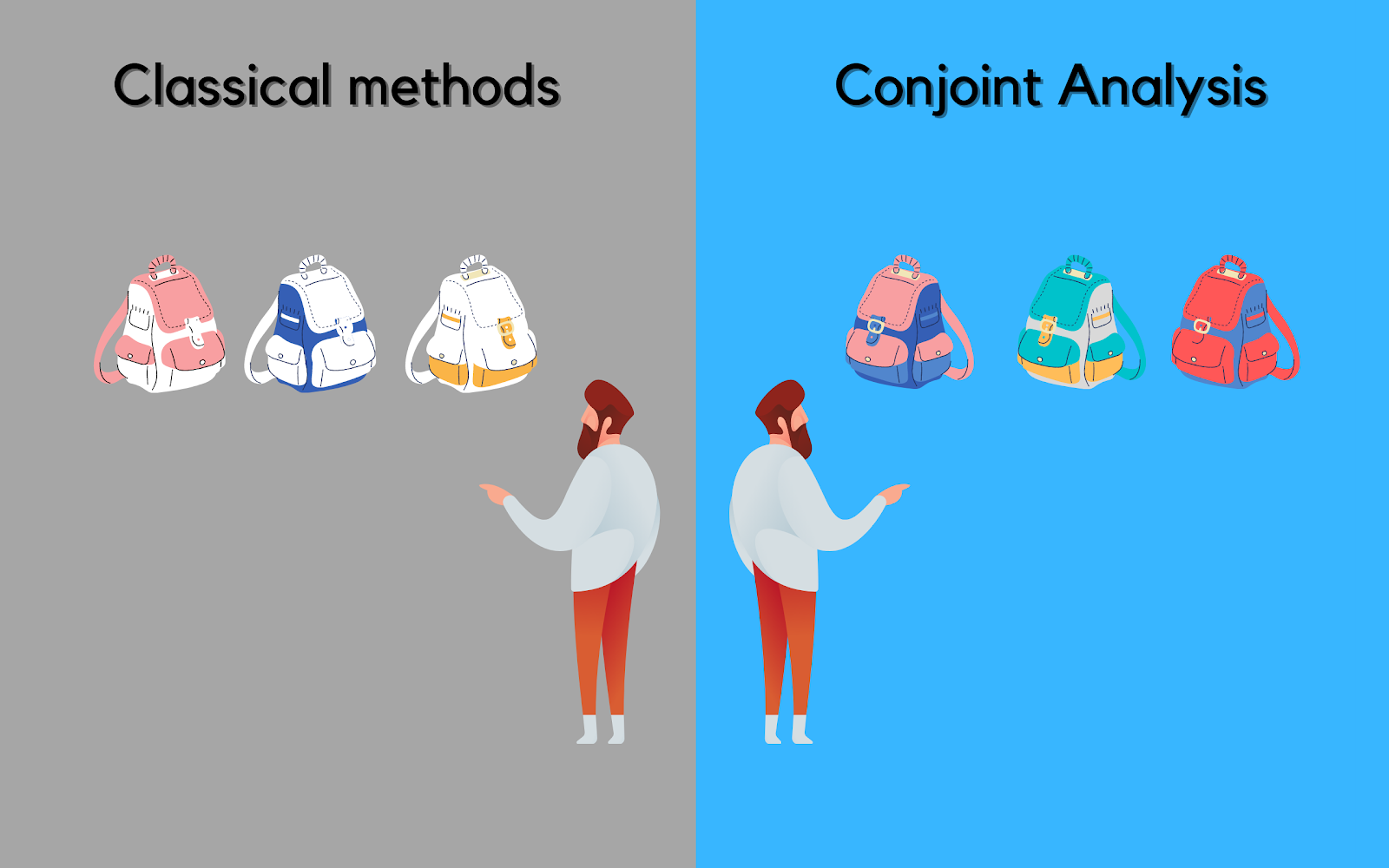
Using conjoint analysis, you can understand how customers make their choices, what trade-offs people would make when given different product features and different levels of its attributes and how attributes interact with each other.
Example of conjoint analysis
To illustrate how simple and robust is basic conjoint analysis, let’s do some as an exercise. We will conduct one of the traditional types of conjoints — Full-Profile Conjoint Analysis. It is relatively simple to demonstrate.
There are other types, like Adaptive Conjoint Analysis (ACA), which is generally more suitable for larger problems.
See also my article about Choice-based Conjoint Analysis:
Conjoint Analysis: Using discrete choice modelling in market research
The business problem
Watermelon LLC — newly funded producer of smartphones asks for your help in understanding their market environment.

They want you to know what features and functionalities they should focus on in the first place when they are planning their portfolio of the devices.
They want to know:
- What functionalities of a smartphone are most influential in terms of market success?
- What do consumers focus on when making their purchase decisions?
- How does each attribute influence price?
Attributes

After a conversation with their product manager, you choose these attributes and levels:
Available memory:
- 32 GB
- 64 GB
Screen size:
- 5’’
- 6’’
5G-capability:
- YES
- NO
Price:
- €999
- €1199
Rather than educated guesses, it’s usually a good idea to put some extra effort into qualitative research. One of the possibilities is focus groups.
As we have only 4 attributes to explore, Full-Profile is an excellent approach. It is especially useful when the number of attributes is no more than 6 and thus it is relatively simple to demonstrate.
Attributes are independent aspects of a product or a service (brand, price, size, colour, etc.). Each attribute has varying degrees, or “levels”. Another advantage of having fewer attributes is that too many features may cause respondents to simplify looking only at 2–3 most important.
Profiles generation
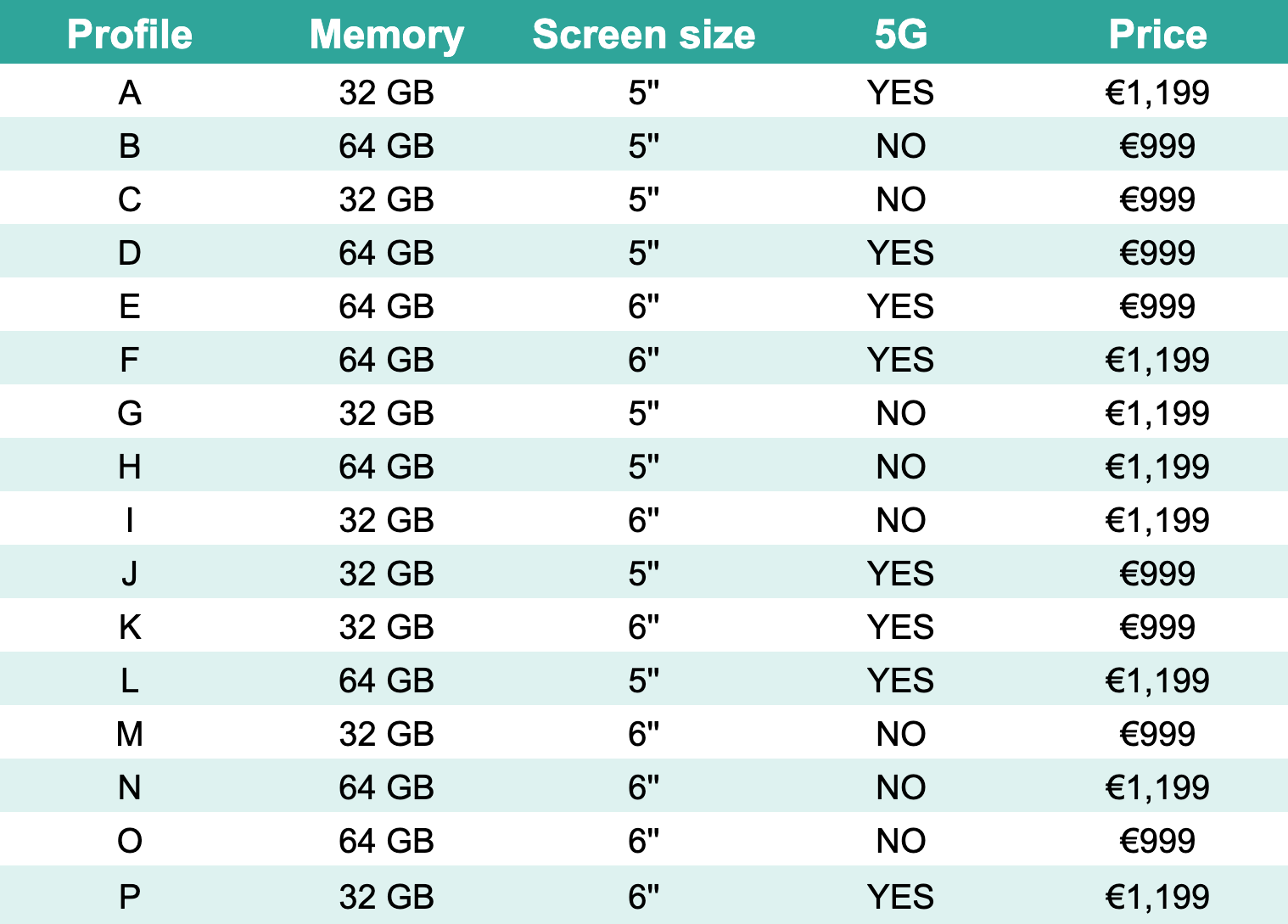
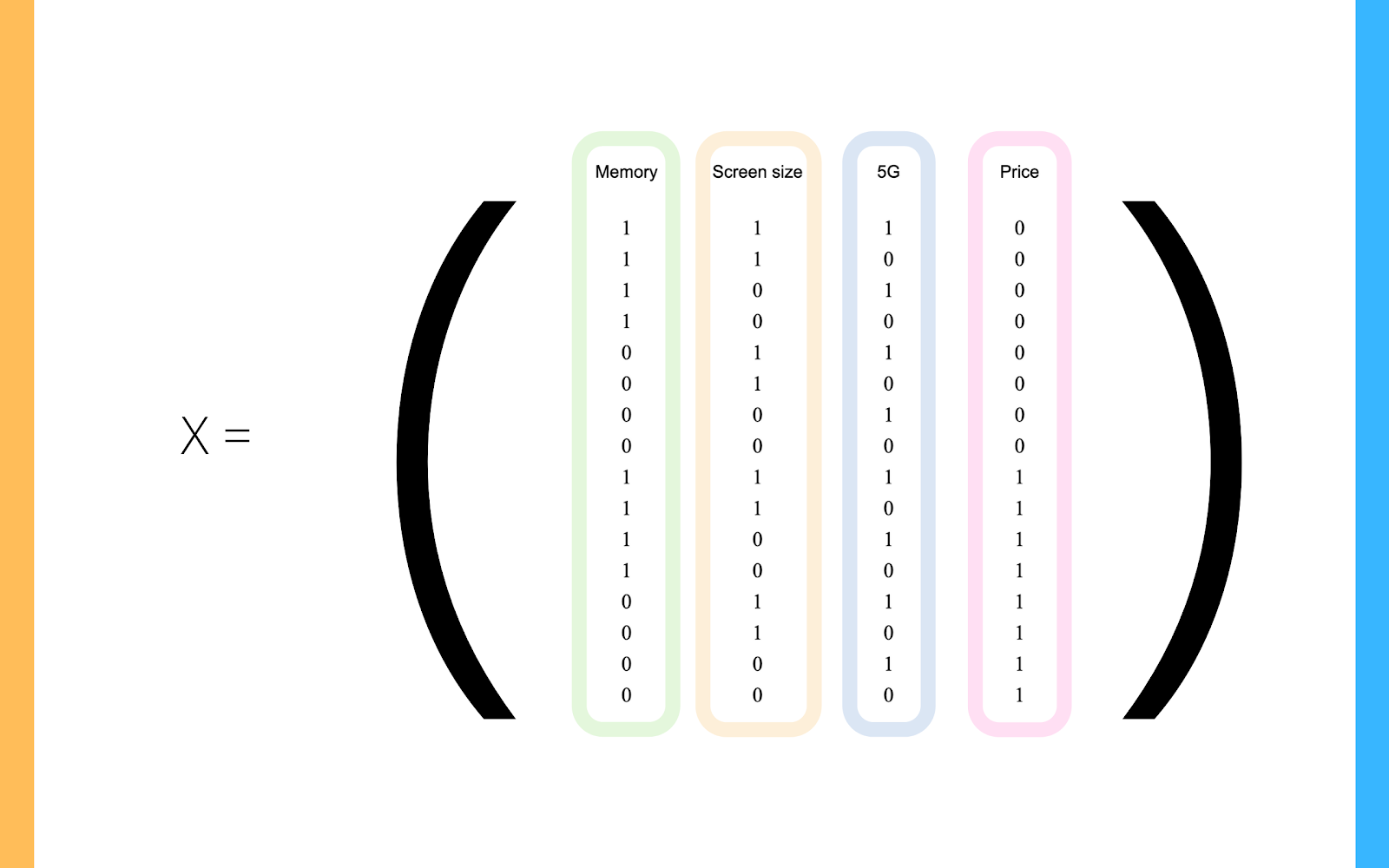
The Full-Profile factorial experiment takes into account all combinations of levels of individual factors, so-called profiles. It is mean that you should generate profiles as every possible combination of levels of attributes.
Most major statistical software has the functionality of designing such experiments.
Data collecting
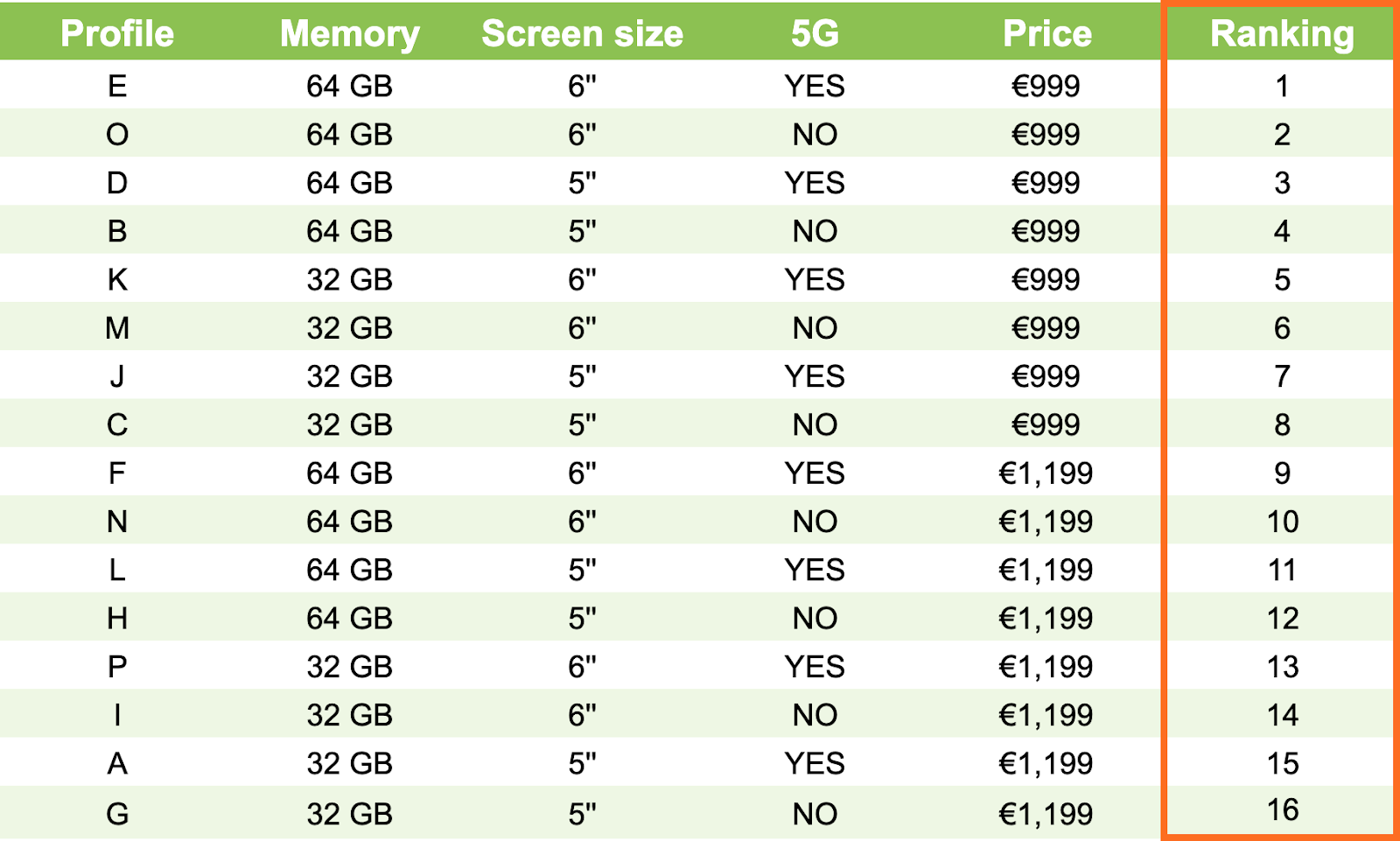
To collect market research data by asking potential consumers to rank generated previously profiles, you can:
- survey your clients through an online questionnaire,
- show them printed cards of each profile.
Sidenote: modern approaches of conjoint analysis also include the possibility to collect actual choice data, e.g. data where the person actually makes a decision between several alternatives.
Building a regression model
Once we have a set of values of the dependent variable, we can try to fit the model for data. We will use multiple regressions for this.
Assuming that the consumer uses some internal additive point system to evaluate the overall attractiveness of each profile, we can introduce a simple linear model.

Parameters of the model, which we call part-worths, are numerical scores that represent how much each attribute influences the consumer’s decision to choose a particular profile. We use the Ordinary Least Squares method to calculate each b-parameter’s numerical value.
Available input:
- Attributes
- Levels
- Respondents
Output of our model:
- Part-worth utilities (b-parameters) for each level
- Importance scores for each attribute
- Ability to perform simulations


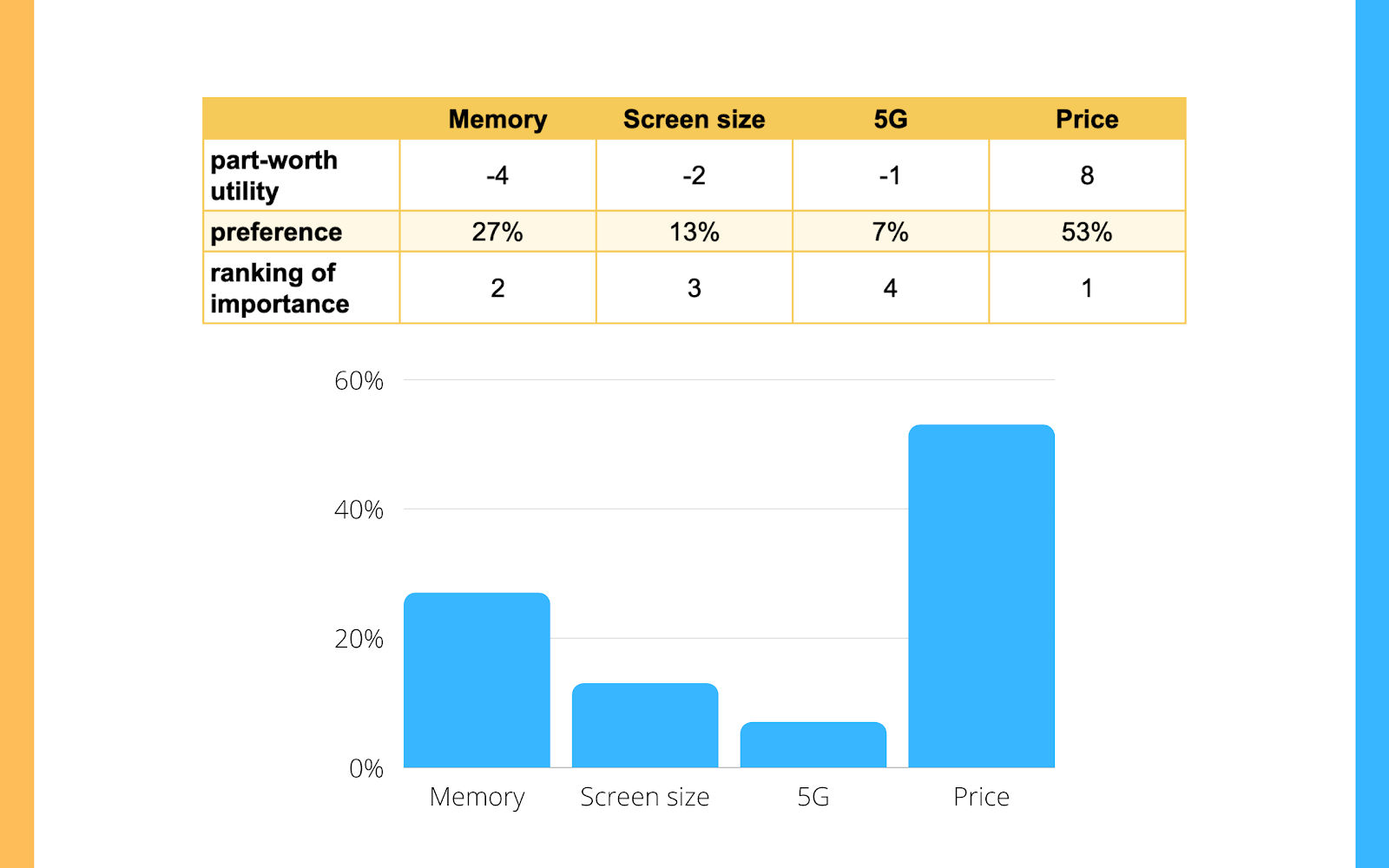
Sidenote: In the real world scenario you should obtain answers from many respondents and then use means of a ranking of each profile.
Conclusions
As you can see in the results, one attribute has a major influence on purchase decisions. It is a price and it is not surprising. (Of course, answers are intentionally biased for this example.)
Let’s repeat regression without considering price as an attribute.
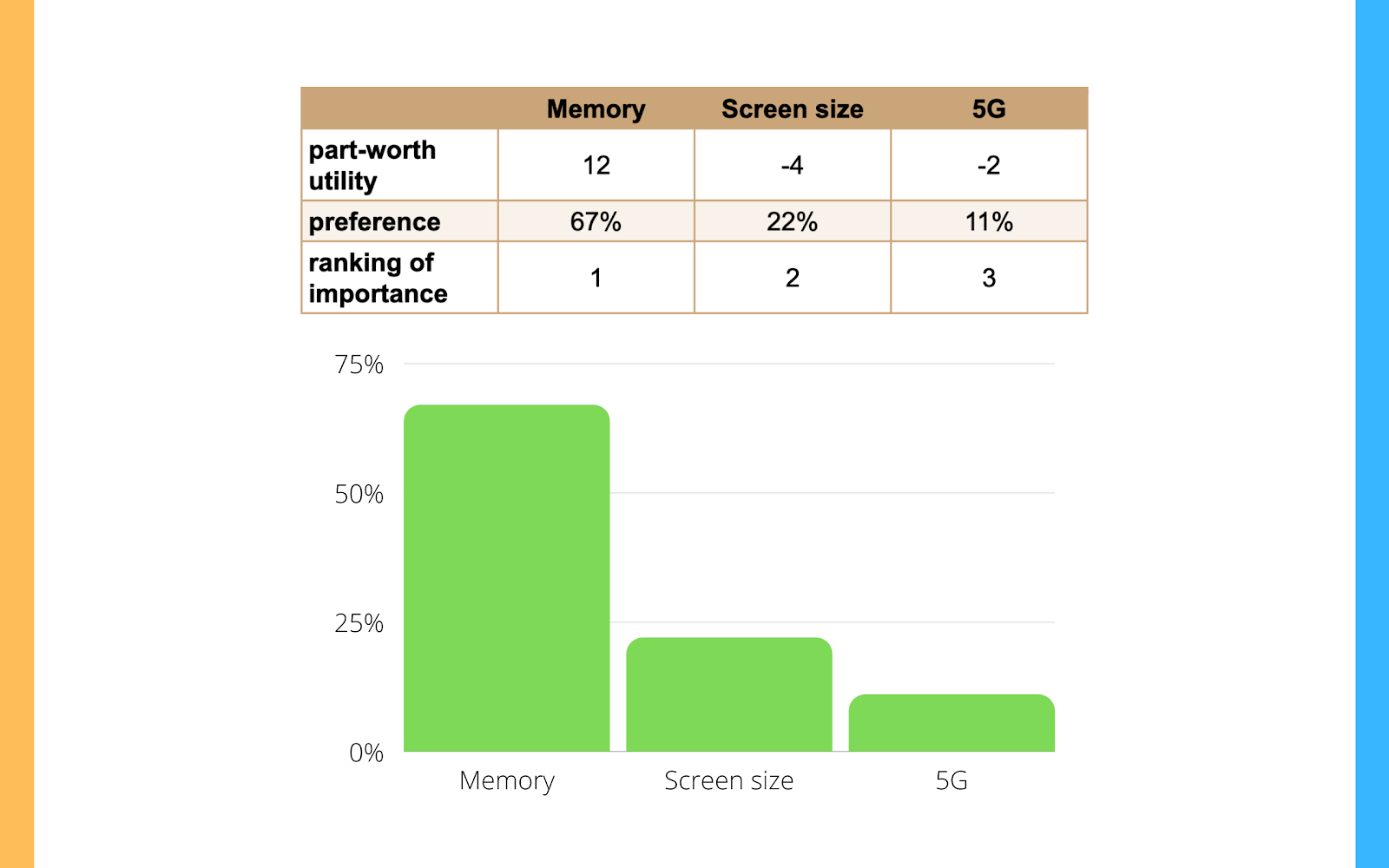
Now, memory is the number one attribute of this respondent.
We know what to recommend to Watermelon LLC already:
- They should focus on making a cheap smartphone with large available memory.
- The second most important feature of a smartphone is screen size.
- 5G-capability is not crucial.
I prepared an interactive website with Full-Profile Conjoint Analysis: https://fischerbach.github.io/full_profile_example/
You can try it yourself and check how the profiles’ ranking influences the calculated importance of attributes.
Takeaways
I hope you understand now what powerful tools conjoint analysis is. Rather than ask directly your consumer about their preferred attributes of the product, you survey them using more realistic questions about their product-focused preferences. When consumers are forced to make difficult trade-offs, we learn what they truly value.
References
- https://sawtoothsoftware.com/academics/teaching-resources
- http://www.dobney.com/Conjoint/conjoint_simple.htm